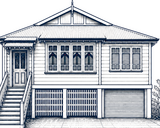
Raising a Queenslander: What to Expect
Raising a Queenslander sounds simple - lift the house up, build underneath, put it back down - but the reality involves a lot of moving parts. This is what the process looked like for our Coorparoo project.
What “raising” actually means
A house raise means temporarily lifting the entire structure off its existing stumps with hydraulic jacks, then either inserting new bearers and stumps at the new height or building a new subfloor frame underneath while the house is suspended. For a Queenslander build-under, the house typically goes up to somewhere between 2.4m and 3m under floor level, which gives enough height for a liveable ground floor underneath.
Who does the work
House raising in Queensland is specialist work done by licensed house raising contractors, and only a handful of established operators cover South East Queensland. You won’t find them on Hipages - word of mouth and recommendations from structural engineers are how most people find one.
The raiser coordinates with a structural engineer who designs the temporary works (the lifting system) and the permanent new subfloor structure. Your builder or you as owner-builder then coordinate the slab and framing work that follows.
The sequence at our place
-
Structural engineering: Our engineer specified the new bearer and joist sizes, the stump positions and the connection details for where the old sub-floor would tie into the new build-under framing.
-
Pre-raise preparation: Inside the house, some internal walls needed temporary bracing. Services (water, gas, electrical) were disconnected or given enough slack to move with the house.
-
The raise itself: Our raiser used a hydraulic jack system spread across approximately 30 jack positions. The house came up over about four hours. It’s slow, controlled and genuinely impressive to watch.
-
Temporary support: Once at height, the house sits on temporary steel frames (or timber crib stacks) while the permanent sub-floor structure is built up underneath.
-
Permanent subfloor installation: New stumps, bearers and joists were installed. This took about a week.
-
Lowering: The house is lowered onto its permanent new subfloor and bolted down. Services are reconnected.
How long does it take
The raise itself - getting the house from ground to full height - is typically one to two days, while the temporary support and permanent subfloor work takes anywhere from a week to three weeks depending on the complexity of your project. Our total from first jacks in to services reconnected was about two and a half weeks.
What it costs
House raising costs vary with the size of the house, the height being raised, access constraints and the specific contractor. Our Coorparoo raise, completed in 2018, cost $42,000 for the contractor and $6,500 in structural engineering fees, which came to $48,500. That figure is separate to the slab, the build-under framing and any reinstatement works, so for a current quote get at least three written tenders from licensed raising contractors in South East Queensland.
Things worth knowing
Access is critical. The raising equipment is large, so if your block has tight side access, that affects how the contractor sets up and may add cost.
The house will creak and move. This is normal. Old Queenslanders are flexible structures - they were designed to move - and some settlement of plasterwork and joinery is expected.
Disconnect everything properly. Services that aren’t properly isolated before the raise will get damaged. We had our plumber and electrician on site the day before.
Your neighbours will want to watch. It’s not every day a house gets lifted two and a half metres into the air.
Raising a Queenslander: common questions
Based on the Coorparoo, Brisbane project.
What does raising a Queenslander involve?
House raising means temporarily lifting the entire structure off its existing stumps using hydraulic jacks, then building a new subfloor at the target height before lowering the house back down. For a build-under, the house is typically raised to 2.4-3.35 m under floor level, so a full liveable ground floor can be constructed underneath.
How much does it cost to raise a Queenslander?
Our Coorparoo raise cost $42,000 for the contractor and $6,500 in structural engineering fees, in 2018 dollars, as part of a project that ran through 2020. For a current quote on a comparable raise, contact licensed raising contractors in South East Queensland directly. Costs vary with house size, target height and access conditions.
How long does a Queenslander raise take from start to finish?
The raise itself - getting the house to full height - takes one to two days. The temporary support and permanent subfloor installation takes a further one to three weeks. Our total from the first jack positions being set to services being reconnected was about two and a half weeks (18 days).
Do I need a structural engineer to raise a Queenslander?
Yes. The structural engineer designs both the temporary works (the lifting system and crib supports) and the permanent new subfloor structure (bearers, stumps, connection details). Using an engineer who has worked with your raising contractor before is a real advantage, because it avoids back-and-forth over specifications during the job.
Can I live in the house during a Queenslander raise?
During the raise itself (raise day and the temporary support period), the house is uninhabitable - services are disconnected and access inside stops once it leaves its stumps. During the following build-under construction, it depends on your project scope and safety requirements. Most owner-builders vacate for the raise and temporary works period at minimum.
How do I find a house raising contractor in Brisbane?
House raisers in South East Queensland are a small, specialist group, so you won't find them easily on general trade directories. The best approach is a referral from your structural engineer, who will likely have worked with local raisers before. Get at least three quotes and check references before committing.
Newsletter
Follow the build
One documented Coorparoo project - the costs, the approvals, the calls we would reverse. Lessons that translate, straight to your inbox.