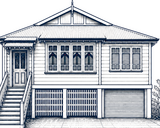
Power Pole Placement in Brisbane
Most homeowners never think about power pole placement until a pole appears, gets moved or is proposed in a position they didn’t expect. By the time you notice it, the engineering decisions have usually been made.
This article covers how pole placement decisions are typically made in Brisbane, what factors drive them and what options homeowners have if a placement is going to affect their property. It draws on our experience working through an Energex pole and transformer placement near our renovated Queenslander in Coorparoo.
How pole placement decisions are typically made
Power poles in Brisbane sit in the road reserve: the strip of public land between the property boundary and the road itself. The road reserve is typically managed by Brisbane City Council, while the electrical infrastructure within it is owned and operated by Energex.
Decisions about pole placement are usually shaped by:
- Network design. Power needs to flow efficiently through the network. Pole spacing, transformer locations and line routing are all engineered to deliver power reliably to the surrounding properties.
- Underground services. Water mains, sewer lines, gas mains, telecommunications and stormwater all share the road reserve. Pole footings can’t conflict with these services and sometimes existing underground infrastructure forces a particular placement.
- Geological conditions. Rock close to the surface, soil stability and other ground conditions can rule out some positions and force others.
- Road and footpath geometry. Poles can’t sit in driving lanes, can’t unduly obstruct footpaths and can’t compromise sight lines at intersections.
- Existing easements and historical infrastructure. A pre-existing pole in a particular spot often shapes the long-term placement of its replacement, especially if underground services were laid around the original asset.
The decision usually involves both Energex (as the asset owner) and council (as the manager of the road reserve). Where the boundary of authority sits between them isn’t always obvious from the outside.
When a placement decision changes
Initial communication from a utility about where a pole will go is sometimes preliminary. Several things can shift a placement after that first conversation:
- Excavation reveals unexpected obstacles. Crews may dig at the planned location and find water mains, rock or other underground services that rule it out.
- Engineering review identifies new constraints. Detailed network design can surface issues that weren’t visible at the initial planning stage.
- Compliance requirements change. Updated standards for pole construction, transformer capacity or clearances can drive different positioning.
- Adjacent development affects the network. A new subdivision or major build nearby can change the load profile and the optimal pole location.
This is why verbal indications about pole placement should be treated as preliminary unless they’re confirmed in writing as a final decision.
Our experience
In our case, an aged double pole and transformer had been in our area for around 70 years. As part of nearby development, Energex needed to replace the existing infrastructure with a single larger pole capable of carrying the existing transformer.
Initial communication with us indicated the new pole would sit on the corner of the block, between our property and the neighbouring development. That placement was workable for us.
The pole was first installed in a temporary position: a position where the kerb and gutter were built around its base. Energex has stated publicly that when their crews began excavation at the originally planned position, they encountered large metal water mains and rock within the designated electricity alignment, forcing the temporary placement.
Their stated position now is that, to avoid existing underground services and rock, the new permanent pole will need to go approximately where the historical double pole was: which sits closer to the front of our home than the originally indicated location.
The process is still being worked through.
What homeowners can do if they’re concerned about a placement
If you’ve been told about a pole placement that you’re concerned about, here are the levers we’ve seen work or be available:
1. Get the proposed placement in writing
Ask for written confirmation of the proposed placement and the reasoning behind it. Verbal indications can change as engineering work progresses. A written proposal gives you a basis for discussion.
2. Ask about alternative placements
If the proposed location is going to materially affect your property, ask the utility what alternative placements have been considered and why each was ruled out. Understanding the engineering constraints helps you focus your engagement on options that might actually be possible.
3. Understand who has authority
Find out which decisions sit with the utility, which sit with council and which sit with both. The published guidance from each can be a useful starting point. Where you get conflicting answers, written confirmation from each side helps clarify.
4. Engage your local member
State and federal members can sometimes help bring stakeholders together when a decision feels stuck. They have established lines into both the utility and council and they can apply pressure that residents alone may not be able to.
5. Build community engagement
A placement decision that affects multiple properties is easier to shift than one that only affects you. Petitions, community proposals (such as combining a pole relocation with traffic calming or a crosswalk) and engagement from neighbouring residents all help.
6. Document everything
Names, dates, reference numbers, photos and copies of every written communication. If the matter ever needs to be formally reviewed, the paper trail is what carries the case.
What homeowners typically can’t change
It’s also worth being realistic about what’s outside your influence:
- Network engineering needs. If the network needs a pole and transformer to serve surrounding properties, those exist somewhere. Removing them entirely from your area is rarely on the table.
- Underground services. Water mains, sewer lines and gas mains were laid years or decades ago. Relocating them to suit a pole placement is generally not feasible.
- Cost-driven trade-offs. Where a placement adds significant cost, the utility will typically lean toward less-expensive options unless there’s a compelling reason to do otherwise.
A realistic engagement focuses on the placement options that are actually feasible within these constraints, not on options that aren’t.
Property value implications
Infrastructure in the road reserve isn’t value-neutral. A transformer pole near the front of a property can affect:
- Visual appeal and the view from the front of the home
- Buyer perception during sale
- Insurance considerations in some cases
- Practical use of the front of the property (driveway placement, landscaping options)
If you’re at the early stages of a renovation or new build, factoring in the existing and likely future infrastructure on the road reserve is part of the overall investment decision.
Where this fits in the bigger picture
Pole placement is one of several utility and infrastructure questions that can come up during a Queenslander renovation. NBN classification, easement use, water main alignment and stormwater connection points are others. Each one has its own decision-makers and its own process.
For the full Coorparoo build-under case study, including our experience with NBN on a separate issue, see Coorparoo Build-Under: What We Learned About Utilities and Infrastructure.
If you want a structured way to track infrastructure decisions, approvals and costs through your project, our Before You Raise: Readiness Pack and Project Control Pack are designed for exactly that.
This article describes our personal experience and is provided for general information only. It is not legal, financial or professional advice and does not represent the position of Energex, Brisbane City Council or any other organisation mentioned. Policies, processes and classifications change over time. Confirm current requirements directly with the relevant provider before making decisions about your own project.
Newsletter
Follow the build
One documented Coorparoo project - the costs, the approvals, the calls we would reverse. Lessons that translate, straight to your inbox.