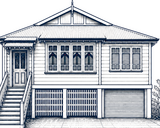
What Happens on House Raise Day
Raise day is one of the most memorable days of a Queenslander renovation. Here is a detailed account of what actually happens, based on the Coorparoo project raise in 2018.
The night before
Services must be disconnected before the house moves. The day before the raise, your plumber and electrician need to be on site to isolate water, gas and electrical connections. These are usually flexible connections or loops of pipe/cable that allow some movement, but they need to be checked and isolated before the jacking begins.
Clear the subfloor of anything you don’t want crushed. Once the house is up on temporary supports, that space becomes a working site, so anything left underneath is in the way.
Raise day: early morning
The raising contractor typically arrives at first light: 6am or 6:30am is common. The crew is usually three to five people for a standard Queenslander raise.
The first job is marking and preparing jack positions. For the Coorparoo raise, approximately 30 jack positions were spread under the floor. The hydraulic jacking equipment is slid into place under the bearers.
The test lift
Before the full raise begins, the contractor does a test lift: typically 50mm to confirm all jack positions are bearing correctly and no unexpected issues are present. This is when you want to be watching: if anything looks wrong (a beam not moving uniformly, a jack position sinking), it shows up immediately. If the test lift is clean, the systematic raise begins.
The main raise
The house rises in increments: typically 100mm per pass, cycling through all jacks. Each cycle takes approximately 15-20 minutes. The process is slow, controlled and supervised at every jack point.
At the Coorparoo raise:
- The house was at first-floor-joist height in roughly 4 hours
- Full height (3.35 m under floor level) was reached by mid-afternoon
- Total raise time: approximately 8 hours
Between cycles, the operator walks every jack position. This is not a machine-runs-itself process: it requires consistent human supervision throughout.
What you will hear
An old Queenslander creaks and cracks during a raise, and this is normal. Old timber frame buildings are flexible because they were built to move. Several sounds are normal and worth expecting.
- Groaning and creaking as the timber adjusts under the new loading
- The occasional sharp crack: usually a plaster cornice separating or an internal join releasing
- The sound of the hydraulic system cycling
At the Coorparoo raise, a loud crack midway through the day turned out to be an internal cornice separating from a wall. The raising contractor barely looked up. It is completely normal.
A few signs are worth reporting to the contractor immediately, in particular a jack position moving differently from the others, a bearer that appears to be splitting or bowing or any visible structural distress.
When the house reaches full height
Once at target height, the raising crew installs the temporary support system: typically steel frames (sometimes timber crib stacks) under the bearers at key positions. The jacks are released and removed. The house now sits on temporary supports.
At the end of raise day, the house is at height. Nobody goes inside until the engineer has confirmed the temporary works are correct and structurally acceptable.
After raise day
The house remains on temporary supports while the permanent subfloor is built underneath. On the Coorparoo project, this took 11 days before the house was lowered.
Three things matter while the house sits up on temporary supports.
- Daily checks of the crib supports are the owner-builder’s responsibility
- No heavy work can happen inside the house
- Site security matters more: the house is more accessible and vulnerable
House raise day: FAQ
How long does raise day take?
For a standard 3-4 bedroom Queenslander raised to 3 m or more, raise day typically takes 8-10 hours from first jacks in to the house at full height and temporary supports in place. Allow a full day.
Can I stay in the house while it's being raised?
No. Access inside the house stops once it leaves its stumps. Plan to be on site all day: outside.
What if something goes wrong during the raise?
Experienced raising contractors have seen most things. The systematic incremental approach means problems show up gradually and can be addressed. The main risks are an unexpected condition in the existing structure (a beam weaker than expected) or unexpected soil conditions at a jack position. Your structural engineer should have assessed the risk before the raise day.
Do I need to be present on raise day?
Yes. As the owner-builder, you are the responsible party on site. You should be present, be contactable and be prepared to make decisions if the contractor identifies any issues.
Newsletter
Follow the build
One documented Coorparoo project - the costs, the approvals, the calls we would reverse. Lessons that translate, straight to your inbox.