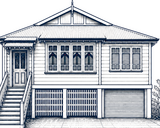
Researching a Relocated Queenslander
Many Brisbane Queenslanders are not where they were originally built. House relocation - moving a house from one block to another - was common throughout the 20th century, and the practice continues today. Here is what you need to know if you suspect your Queenslander has been relocated.
Why it matters
A relocated Queenslander has a complex structural and approval history. The relocation process involves disconnecting the house from its foundations, transporting it (sometimes significant distances) and reinstalling it on a new block. That process affects four things worth checking.
- The structural condition of the frame, connections and fixings
- The approval history, since the house may have been approved on its original site, but carries different approvals on its current one
- The pre-1947 overlay status, because the character overlay applies to the current site rather than the original
- The asbestos risk, since a relocated house may have been modified at any point in its history
Signs a Queenslander may have been relocated
- The house style or construction period doesn’t match other houses in the street
- The house is notably smaller or larger than typical for the era and suburb
- The placement on the block seems unusual (set back, off-centre, rotated)
- The subfloor connections or stumps look relatively modern compared to the house structure
- The house has been described in marketing material as “relocated” or “transported”
- An unusual gap or change in construction quality is visible where the house joins any additions
How to find out if a house has been relocated
Brisbane City Council records. An ePlanning search may show when the current development was approved on the site. If the approval date falls well after the estimated construction date of the house, relocation is one possible explanation.
Queensland State Archives. Historical aerial photography and survey plans can show when structures first appeared on a block. If a house clearly visible in 1960 aerial photography disappears and reappears on a different block in 1975 photography, it was likely relocated.
Queensland Globe. Historical aerial imagery via the Queensland Government mapping portal (qld.gov.au) allows comparison of different years. This is one of the most practical tools for determining when structures appeared on a site.
Neighbours and local history groups. Long-term residents and local history groups (particularly in inner Brisbane suburbs) often know when houses were moved.
The structure itself. A building historian or experienced inspector can sometimes identify structural features that suggest relocation: different timber species used in different areas, connections that suggest reinstallation or frame elements that don’t match.
What it means for buying or renovating
For purchase: A relocated house may have structural issues arising from the relocation (connections loosened, frame distorted, subfloor not properly settled). A detailed structural inspection is essential.
For a raise: If the house has been relocated, the structural engineer needs to assess it as a relocated structure with its own history. The engineer’s starting point for designing the raise subfloor and temporary works may be different from an in-situ house.
For council approval: The council will assess the house on its current site. The original approval on the previous site has no relevance to the current site’s approval requirements.
Relocated Queenslanders: FAQ
Is a relocated Queenslander structurally inferior to an in-situ one?
Not necessarily. A well-relocated and properly reinstalled Queenslander can be structurally sound. The relocation process can, however, cause issues that need investigation, such as loosened connections, frame distortion and subfloor problems. Always get a thorough structural inspection.
Does it matter for a Brisbane character overlay if the house was relocated?
The character overlay applies based on the house's presence on the current site. A relocated pre-1947 Queenslander can be within a character overlay on its current site. What matters for the overlay is the construction date of the structure and its location on the current site, not its original location.
How do I find out the original location of a relocated Queenslander?
Historical archives, council records and local history groups are the main sources. Queensland State Archives holds survey records and some relocation approvals. Local historical societies in Brisbane suburbs are often surprisingly well-informed about house movements in the area.
Newsletter
Follow the build
One documented Coorparoo project - the costs, the approvals, the calls we would reverse. Lessons that translate, straight to your inbox.